A surface sloped at 45 degrees or more sheds water on its own. A flat one holds that water until somebody arrives with a hose. This single difference explains why two conveyors built to the same material specification behave nothing alike at the end of a shift.
In most food plants the hygiene discussion starts at the belt and ends there. The belt is visible, it touches the product, and it carries a brand name. Yet lines rarely fail a hygiene check because of the belt alone. They fail at the places nobody wrote into the specification: an interrupted weld on a support leg, an upward facing angle under the carryway that fills during the rinse, or a pair of hands reaching in to straighten product.
Hygienic conveyor design is the work of removing those places before the line exists. It is a set of decisions about shape, joining, slope and product handling, and each of them is cheap while the line is still a drawing.
This article sets out the four rules we apply on every food line we design, then the four food grade belt families we build those lines with. The rules stay the same across the plant. The belt changes with the zone.
The Problem: Stainless Steel Is Not a Hygiene Guarantee
Buyers often treat hygiene as a material question. The specification calls for stainless steel, the frame arrives in stainless steel, and everyone assumes the matter is settled. Then the first full washdown happens.
What the cleaning crew finds is that soil does not settle on open, sloped surfaces. It settles where the geometry invites it. A dead corner inside a welded joint traps product. A flat pocket in a frame member keeps water long after the rinse has finished. A stitched seam, the shortcut that saves fabrication time on a structural frame, leaves a row of small gaps along its length, and every gap is a pocket that no wash stream reaches and no inspection sees.
Handling adds a second layer to the same problem. Every point where an operator lifts, turns or straightens the product is a point where the product meets something other than the line: a glove, a tool, a table edge, a crate that came from somewhere else. On a labour plan those points look like seconds. In a hygiene audit they are transfer routes.
None of this is a cleaning failure. It is a design decision that only shows itself as a cleaning failure, once a day, at the least convenient hour.
Operational Impact: Where the Cost Actually Appears
The first cost is time, and a plant manager meets it long before anyone writes it into a report. A frame full of hidden pockets sets the length of the cleaning window, and that window sits inside the production plan, not next to it. Because it repeats on a fixed rhythm, a few extra minutes turn into shifts over a year.
The second cost is rework of the cleaning itself. When a surface cannot be verified quickly, the crew cleans it again to be safe, and a failed swab sends the whole zone back to the start. Rechecking a line is not planned work, so it lands on top of a schedule that was already full.
The third cost arrives months later, and it starts inside a weld. Moisture held in a stitched seam has nowhere to evaporate, so the metal corrodes from within the joint outward, and the repair is structural rather than cosmetic. A line that resists cleaning does not only slow the crew down. It shortens its own service life.
The fourth cost is the handling itself. Manual intervention consumes operator hours, and it makes the flow inconsistent, because no two operators feed a machine at exactly the same rhythm. For purchasing, this is the part that never appears in the equipment price and always appears in the running cost.
The Four Rules Behind Our Hygienic Conveyor Design
Hygiene is not a property of one component. It is the sum of the decisions taken across the whole line, and four of those decisions carry most of the weight.
Rule 1: Surfaces that hold nothing
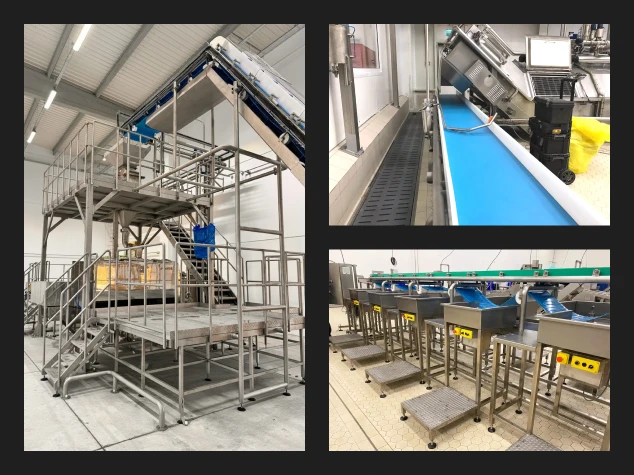
We design the frame so that product and water have no place to gather. That means no dead corners inside joints, no flat pockets in structural members, and no upward facing channel that becomes a tray once the line is washed. Where a horizontal face cannot be avoided, we keep it narrow and open underneath.
For the plant this changes the nature of cleaning. The crew stops hunting for hidden soil and starts confirming clean surfaces, which is faster and, more importantly, verifiable.
Rule 2: Continuous weld seams
We run weld seams continuously instead of stitching them. A stitched seam is structurally adequate and hygienically poor: every unwelded interval is a narrow slot that fills with product, holds moisture and hides from inspection. We then dress those seams so the surface stays smooth rather than porous.
The business effect is simple. A frame with continuous seams can be cleaned in a predictable time, and it does not develop the corrosion that starts inside a gap and finishes as a structural repair.
Rule 3: 45 degrees and steeper
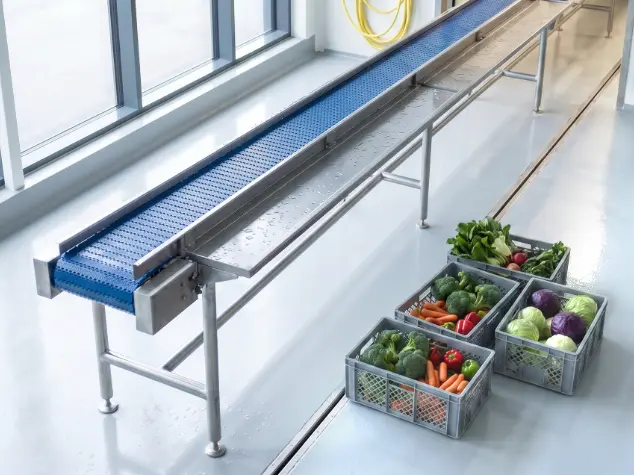
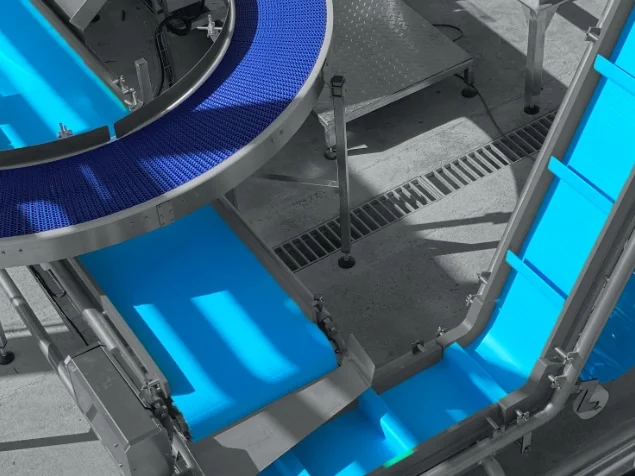
We build frame and equipment surfaces at a slope of 45 degrees or more wherever the structure allows it. Below that angle a film of water clings to the surface and dries there, together with whatever it carried. Above it, water and residue leave on their own while the crew is still working elsewhere.
What this means on the floor is that the line begins drying and draining the moment the rinse stops, instead of waiting for a wipe down. Every surface that empties itself is a surface nobody has to reach.
Rule 4: A system that reduces handling
The last rule is not about steel at all. The fewer points at which a human touches the product, the fewer routes contamination has into it. So we design the line to carry the product through the process rather than around it: fewer manual transfers between machines, fewer lift and place steps, fewer buffer tables where product waits in a crate.
This is where hygiene and output stop competing. A line that needs less intervention is also a line that runs at a steadier rhythm, and steadier rhythm is what downstream packaging machines are actually asking for.
Four Food Grade Belts, and What Each Zone Asks For
The four rules above apply to every food line we build. The belt is the part that changes, because a filling zone, a wet processing zone and a packaging zone do not ask the same question. All four families below are suitable for food contact duty, and each carries its own trade-off.
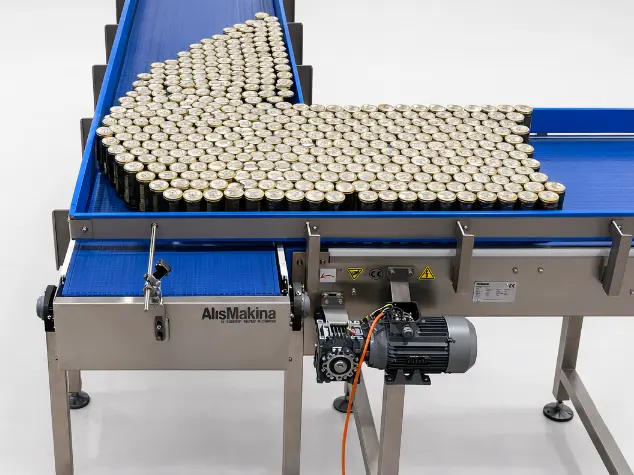
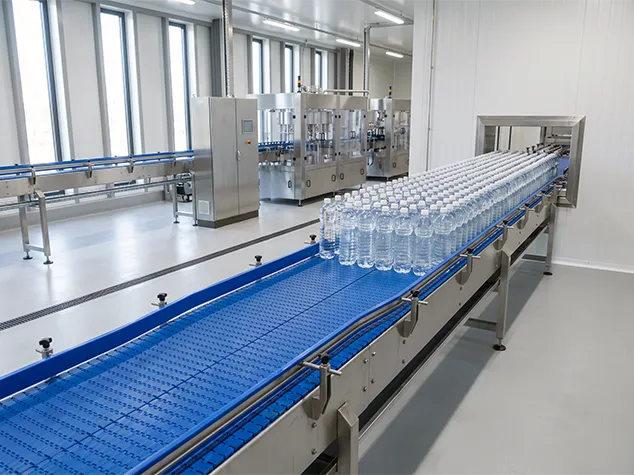
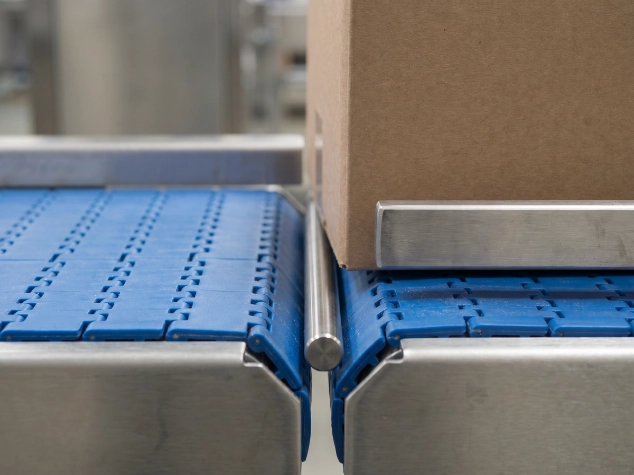
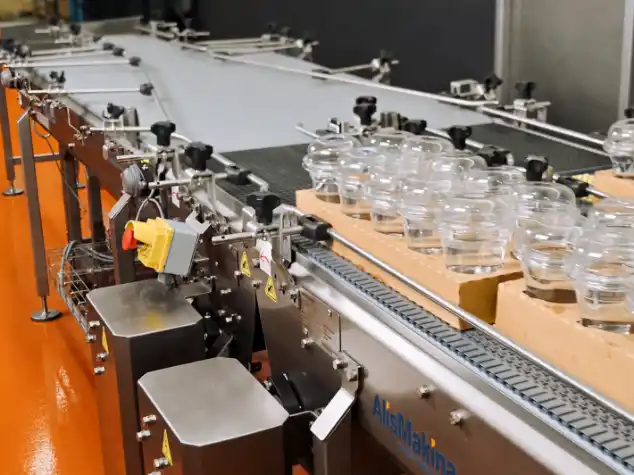
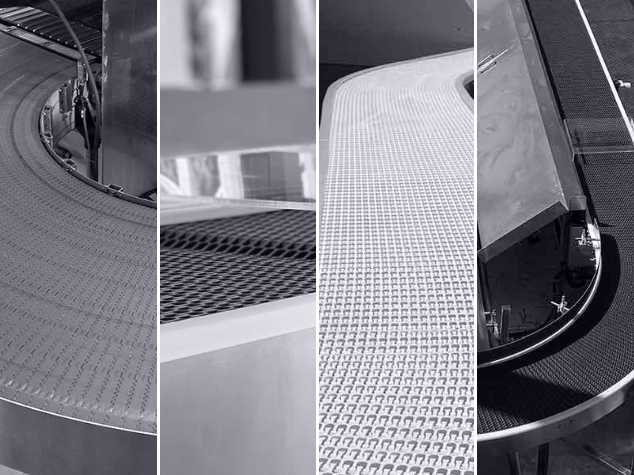
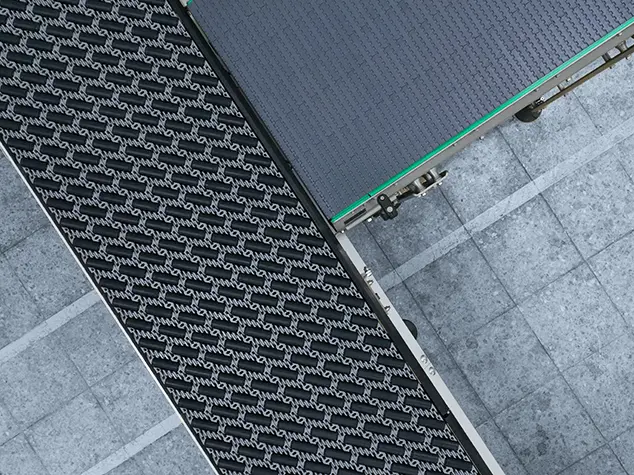
Modular plastic belt. Interlocking modules give the line geometric freedom: curves, inclines, wide carryways, and side transfers that a single piece belt cannot follow. A damaged section comes out module by module rather than as a whole belt. The hygiene cost sits in the joints, since every hinge is a gap that product can enter, so this family earns its place where layout demands are high and where product travels packaged or supported.
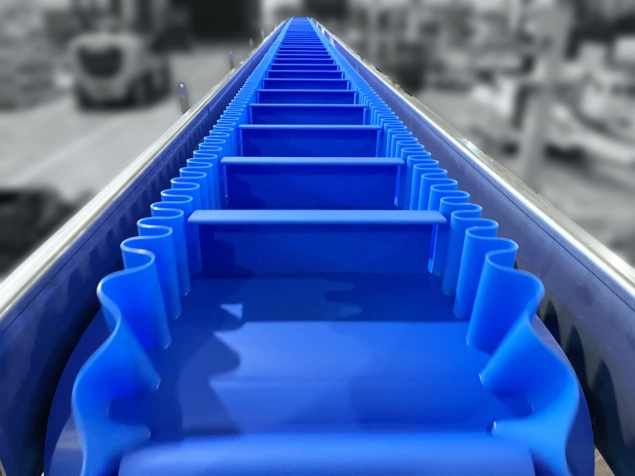
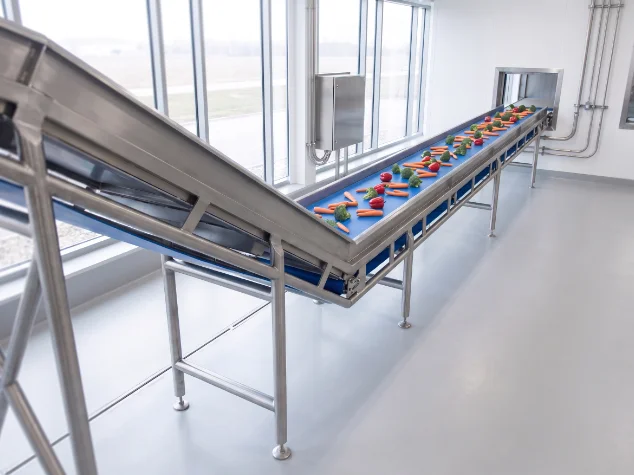
PU belt. A smooth, continuous carrying surface with nothing for residue to enter. It suits open product on straight runs, it wipes down quickly, and it treats delicate product gently because the support underneath is uninterrupted. Its limits are geometric: curves, heavy loads and long accumulating runs push the design back toward another family.
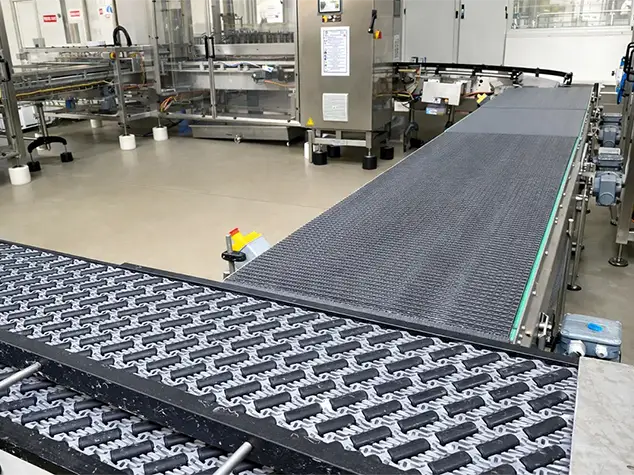
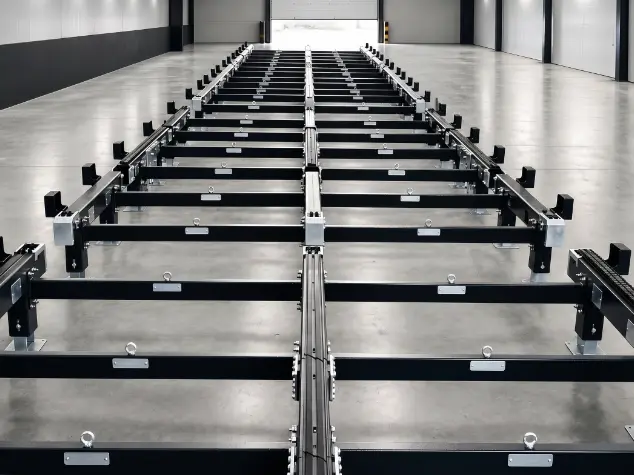
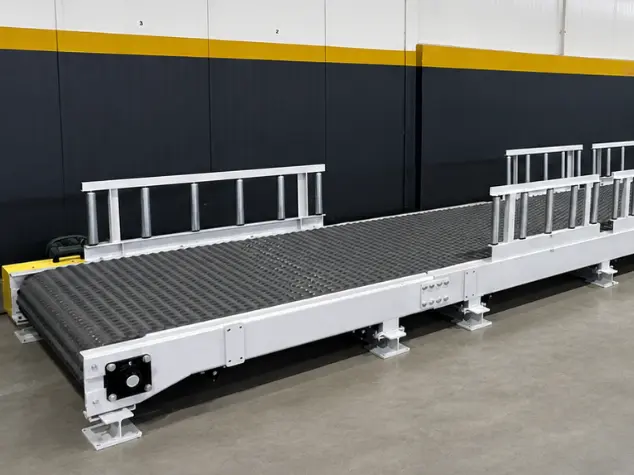
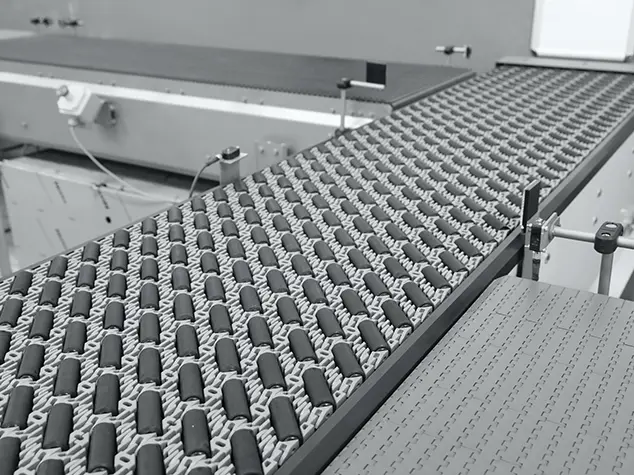
Roller chain. Where the load is heavy, hot or carried in crates and trays, a roller chain handles what a plastic belt cannot. The product usually travels inside a container rather than on the chain itself, which changes the hygiene target: the frame, the guides and the drainage under the chain do the hygienic work. This is the family for oven exits, crate handling and the heavier end of a process line.
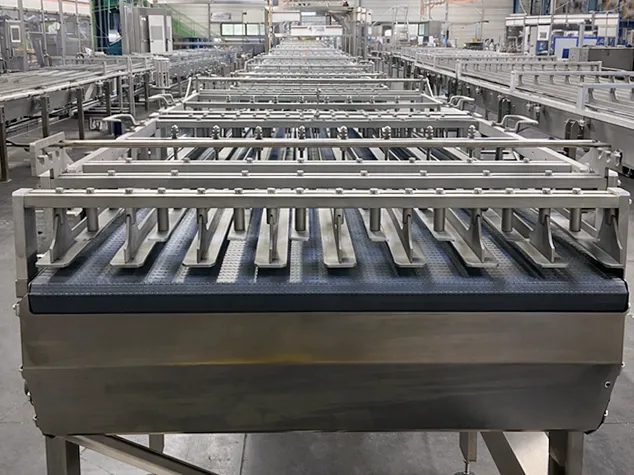
ThermoDrive. A single piece belt with no pins and no hinges, held on its path by drive teeth rather than by tension. Since the underside carries no joints and needs no take-up pockets, there is nothing for product to work into, which makes it the fastest of the four to clean and to verify. It is the family we reach for when the product is open and touches the belt directly. In exchange, the drive geometry and the belt path need more care in design than a friction driven belt asks for.
The point of listing four families is not that any of them is better. It is that a food plant rarely needs one. Most lines we design use two or three, chosen zone by zone, because the wet end and the packaging end are two different problems in the same stainless steel.
Design Criteria: How the Zone Decides the Belt
Six criteria settle the choice, and they are all set before fabrication starts.
The first is the state of the product. Open product touching the belt directly sets the highest bar, since the carrying surface is now a food contact surface. Packaged product moves the hygiene load onto the frame and the surroundings.
The second is the condition of the zone: wet, dry, hot, oily, or a combination. Water and fat behave differently on the same surface, and a belt that performs well after a dry brush down can struggle where foam and hot water are used daily.
The third is the cleaning method and its frequency. A line opened for cleaning several times a day has to release its guards and covers by hand, which is a load path question before it is a hygiene question: whatever comes off quickly must not be carrying the structure while it is on.
The fourth is what the layout demands. Curves, inclines, transfers and accumulation all pull toward specific belt families, and the shortest hygienic line is usually the one with the fewest transfer points in the first place.
The fifth is load and carrier. Weight, temperature and whether the product travels in a crate decide whether a belt or a chain is the honest answer.
The sixth is the drainage path. A surface that sheds water is only useful if the water then has somewhere to go, so the slope of the frame, the position of the legs and the floor drain are designed as one question rather than three.
The Aliş Makina System Perspective
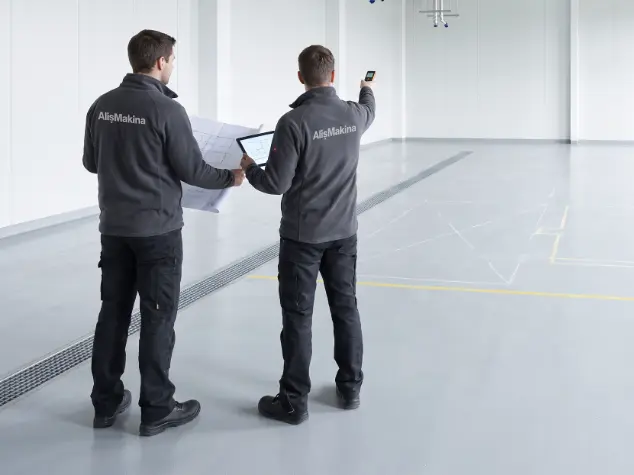
We do not build hygiene into a component and call the line hygienic. Aliş Makina designs the whole transport path as one hygienic system: the frame geometry, the weld quality, the slope of every surface, the number of times a person has to touch the product, and only then the belt.
That order matters. A plant that starts from the belt ends up with an excellent belt inside an awkward frame, and the bill for that frame arrives with every washdown. A plant that starts from the four rules can then choose the belt freely, because the hygiene of the line no longer depends on that single decision.
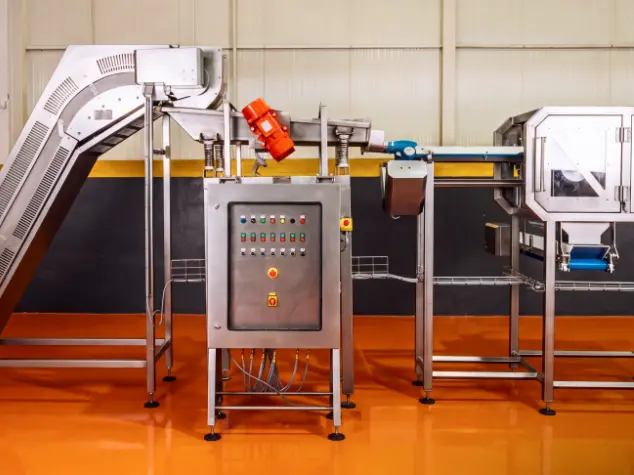
It also means we do not push one belt family. We engineer modular belt, PU belt, roller chain and ThermoDrive sections into the same line where each of them belongs, and we integrate the result into the plant as a continuous flow rather than a row of separate machines.
The goal is a line whose hygiene is a property of its shape. Cleaning then becomes a routine with a predictable duration, instead of a nightly search for the places the design forgot.
FAQ
What makes a conveyor hygienic?
Geometry more than material. A hygienic conveyor leaves product and water nowhere to gather: no dead corners, no flat pockets, continuous weld seams, and surfaces sloped so liquid drains away. The belt matters too, but a well chosen belt inside a poorly shaped frame still produces a line that is slow to clean.
Why do weld seams matter so much on a food conveyor?
A stitched seam leaves a small gap at every unwelded interval. Product enters those gaps, moisture stays behind, and no wash stream or visual check reaches inside. Continuous seams remove that pocket entirely, and they also prevent the corrosion that begins where cleaning chemistry sits inside a joint.
Why design frame surfaces at 45 degrees or more?
Below roughly that angle, water clings to the surface and dries there along with any residue it carried. At 45 degrees and steeper the liquid leaves under its own weight. The result is a line that starts draining the moment the rinse stops, which shortens the cleaning window without any change in chemistry.
Which belt is best for open food product?
For product in direct contact with the belt, a pin free homogeneous belt such as ThermoDrive is usually the strongest choice, because there are no hinges or pockets underneath the carrying surface. A PU belt is a common answer on straight runs. The right decision still depends on the zone conditions, the layout and the cleaning regime.
Can modular plastic belts be used on a food line?
Yes, and they often are, particularly where the layout needs curves, inclines or wide carryways. The design question is where to use them: the hinge gaps make them a better fit for packaged or supported product than for open product that would work into the joints.
Does reducing manual handling really lower contamination risk?
Every manual transfer introduces contact with something outside the line, whether a glove, a tool or a crate. Removing those steps removes those contact routes. It also steadies the flow, because a line that carries the product through the process feeds the next machine more consistently than one interrupted by hand.
Conclusion
Two conveyors can share a material specification and behave nothing alike. What separates them is where their surfaces let water sit, whether their seams are closed, how steeply their frames drain, and how many times a person has to touch the product on its way through.
Those four decisions are made on a drawing and paid for on the floor, every shift, for the life of the line. They cost almost nothing to get right at the start, and they cannot be corrected with a stronger chemical afterward.
The belt then becomes what it should have been all along: a choice made zone by zone, from four food grade families, according to what that part of the process actually asks for. That is what hygienic conveyor design delivers, a line that stays clean because of its shape and runs steadily because it was never designed to be corrected by hand.