Every conveyor line has one part that gets ordered by the meter and described in one line of a specification. It is the rail running along the edge of the belt. On a line carrying heavy cases, that treatment costs nothing. On a line carrying thin-walled plastic tubs, the same rail decides how much product reaches packaging in usable order.
Conveyor side guide design is the decision behind that rail. A guide has two effects on a product, and only one of them appears in the drawing. It holds the product inside its lane, and it also pushes back on that product wherever the two meet. On a heavy item the second effect stays in the background. On a light, slippery item it can grow large enough to park the product where it stands.
This article looks at side guides on light product lines, using a plastic tub line as the working example. It covers where a guide starts producing jams, what those jams take out of a shift, and the mechanics underneath them. The design questions follow from there: how much load arrives at the rail, what sets the clearance, and which jobs never belonged to a guide.
Where the Guide Stops Protecting
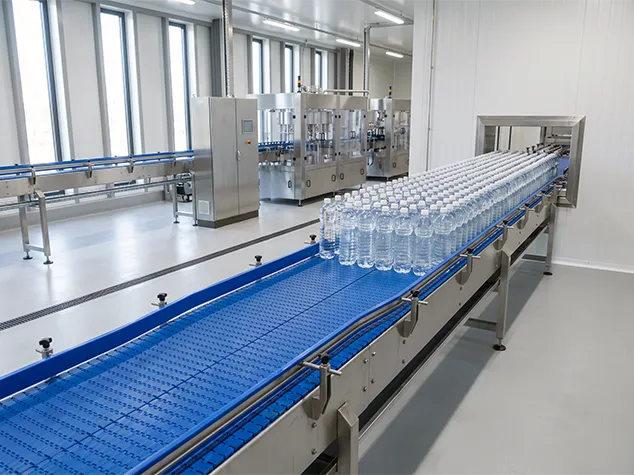
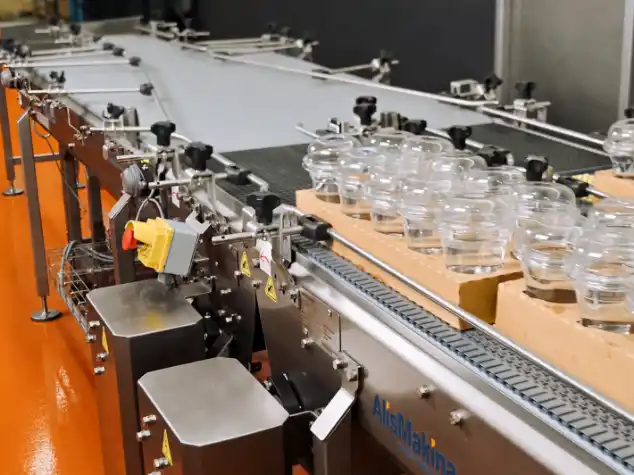
Start with the product. Tubs come out of production light, smooth and easy to move. They have to reach the packaging machine in one row, aligned and facing the same way. A modular plastic belt carries them and holds them from below. What keeps a row a row is the rail beside it.
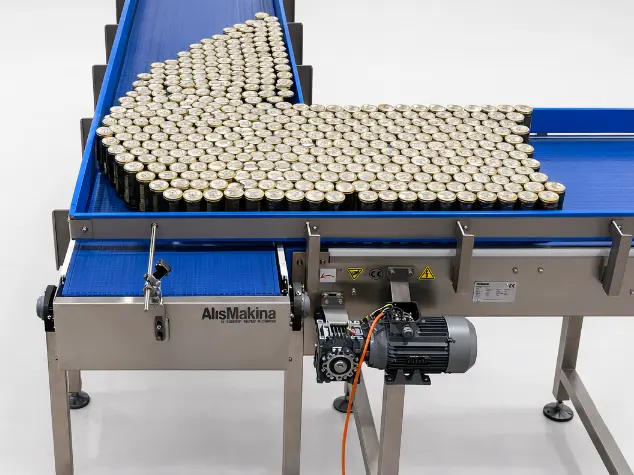
That job is not equally heavy along the line. On a straight run at steady speed the rail has little to do. The belt is already moving every tub in the same direction at the same speed. The rail becomes decisive where the flow has to change shape. That means the convergence where a wide stream comes down to one row, the turns, and the packaging machine intake. That intake is the tightest gap the tubs have to pass through. In those places product travels pressed against the rail instead of beside it.
None of this is visible while the line is new. The first product runs, the rails stay where the commissioning team left them, and the line behaves. The gap opens as soon as conditions move. Another tub size arrives, the line runs faster, or tubs come off the mold at the wide end of tolerance. If the design left no adjustment range in the rails, the correction on the floor is no longer a correction. It turns into cutting, drilling and welding on a line that is supposed to be producing.
The Slow Loss Nobody Logs
A guide problem rarely produces a clean stop. Nothing trips, no alarm sounds, and the line keeps moving. What changes is how much of the plan a shift actually delivers. A loss of that shape can be carried for months without ever being named.
It shows up first at the packaging machine. That machine sets the tempo for everything upstream, and it needs a feed that arrives without gaps and without surges. A tub lying across the lane cuts the feed twice. It blocks the row first, and when the jam clears the queue behind it releases in a burst. Neither state is what the machine was set up for, so it runs below what it can do.
The second cost lands on the product. A tub that travels pressed against a rail carries that contact on its rim. On a packaging item that mark is a cosmetic fault rather than a functional one. Nothing about the tub has failed, and it still gets rejected.
The third is the rail. Every correction made by hand shifts it slightly, and a rail that has drifted out of alignment feeds the next jam. Then there is changeover. When the right rail position lives in somebody's memory rather than in a drawing, every product change begins with a hunt for it. That hunt is paid for out of the first hours of a shift.
Three Forces Acting on the Product
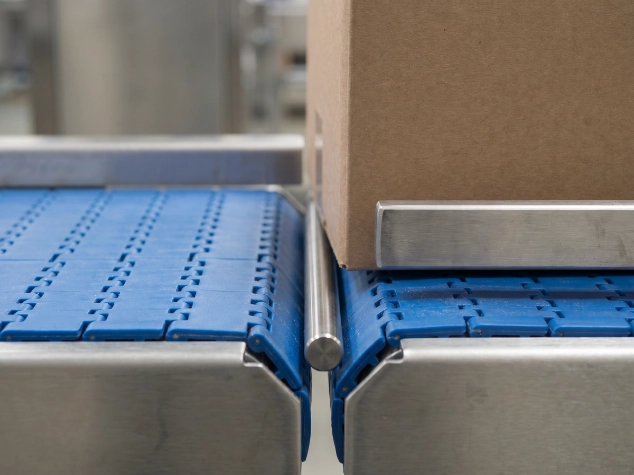
Picture a guide as a wall and the behavior of the line stops making sense. A wall ends movement, while a rail does something different. It takes speed out of the product at the contact point, and the belt underneath keeps driving the whole base. Three effects come out of that difference.
The first is resistance against drive. The belt pushes the tub forward from below. The moment the tub meets the rail, a force appears at the contact, pointing back along the line of travel. On a heavy product the push wins by such a margin that the item slides along the rail and continues. On a light, smooth-walled product the two forces sit close together. Once resistance is the larger of the two, the tub holds still while the belt runs on beneath it. Everything arriving behind it gathers at that point.
The second is rotation. Contact almost never happens along the full side of a product. It starts at a corner. One side is held while the rest of the base is still being driven, so the tub turns about its own axis. When a tub meets the rail at an angle, the contact point decides which way it turns. Contact ahead of the center of mass turns the tub back into the lane, while contact behind it pushes the tub out of line. A wide-based tub rarely tips over, because its base is broad next to its height. It settles at an angle across the row instead, and one tub sitting like that stops everything behind it.
The third is contact height, together with the stiffness of the rail. A sideways force applied high on a product tends to roll it over its own base edge. The same force applied low moves the product sideways instead. On a wide, shallow tub the second outcome is far easier to reach than the first. A rail that flexes outward under load gives up the decision altogether, because the product then finds a way under it or past it.
Taking Load Off the Guide
Once the mechanism is clear, the design question changes shape. It is no longer how to set the rail. It is how much work to leave for it.
Geometry is the first lever. Where a wide stream comes down to one row, a sharp closing angle converts forward motion into a sideways push. The product loses speed at once, and the queue behind it catches up. A longer, gentler convergence lets each item change direction while it is still moving. The trade-off is real: a gentle convergence needs floor length, and floor length is what most plants have least of.
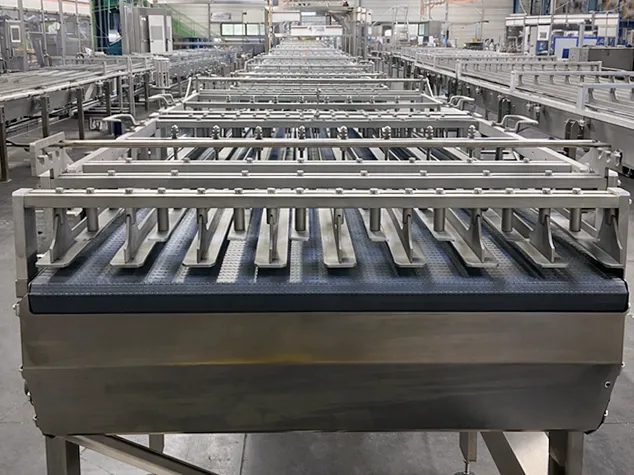
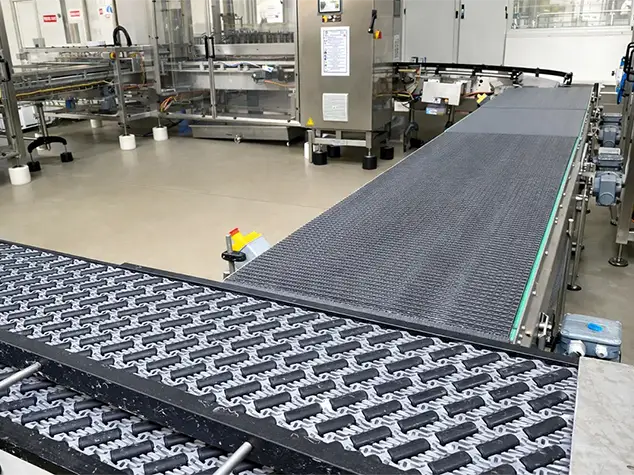
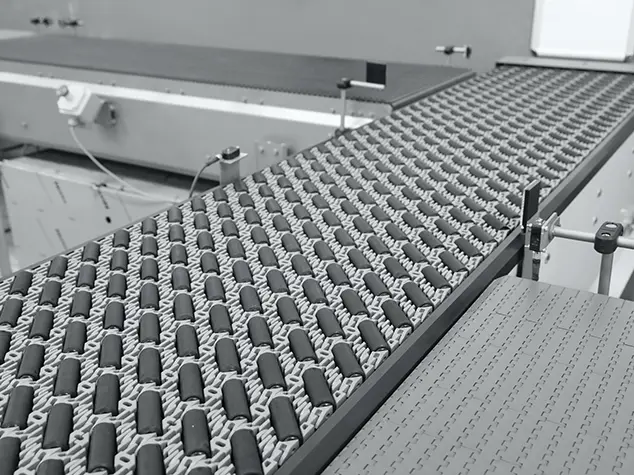
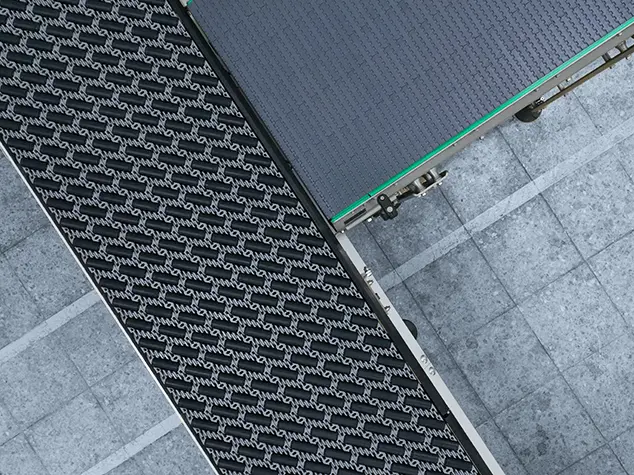
The belt is the second lever, and it acts before product ever reaches the rail. A modular belt whose surface geometry holds each tub where it sits keeps items in their own lane. They then lean on the rail less. That choice is not free either. The same surface that keeps a tub in its lane keeps pushing a stopped tub into the one ahead of it. Grip is therefore decided zone by zone rather than once for the whole line.
Speed is the third. Presence sensors along the run read where product is, and an inverter matches belt speed to the rhythm of the packaging machine. As long as the belt does not deliver more than the machine can take, no pressure builds against the rail.
There is also a point where a rail is simply the wrong tool. Guides organize a flow that is already close to single file. Bringing a wide, disorderly stream down to one row is a flow function of its own. On fragile or thin-walled product it is done pressureless, so items separate without pushing on each other. Handing that work to a rail ends in marked product and a stalled lane.
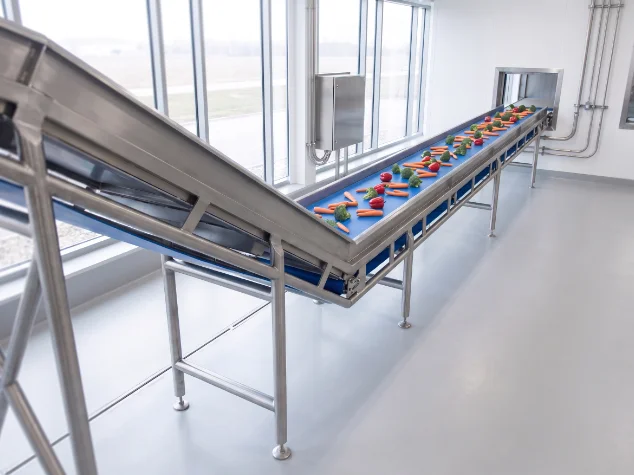
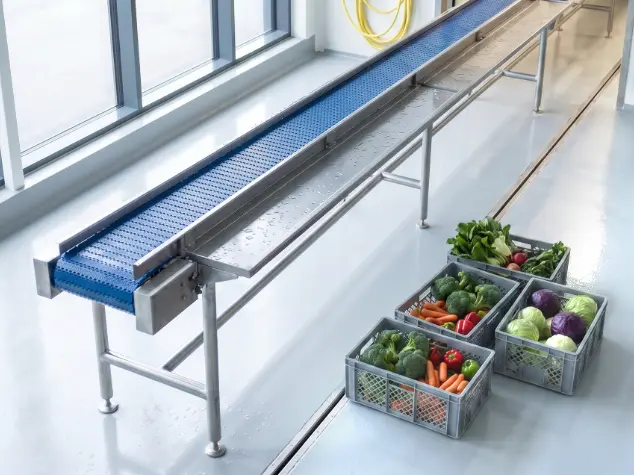
Hygiene shapes the rail as much as flow does. On open product the rail is a food contact surface exactly like the belt, so its brackets and supports have to stay reachable during cleaning. Closed box sections and flat horizontal ledges hold water and residue where nobody can see them. An open, drainable support has an advantage here that has nothing to do with how product moves.
What Decides the Clearance
Clearance is the figure everyone asks for and the one that cannot be copied from a drawing. A thermoformed tub leaves the mold at a finished size that depends on the tool, on cooling and on wall thickness. The drawing therefore describes an intention rather than the item on the belt. Set the rails to the drawing and the widest tubs in a batch will bind. Leave the rails too generous and the row quietly doubles up, because two narrow tubs will find space side by side. The working answer passes the widest tub production actually delivers and refuses a second one beside it.
Product form settles the rest of the geometry. Weight and base width decide how much resistance an item absorbs before it stops, and height decides where the rail should meet it. Line speed decides how hard each contact is, since the same clearance behaves differently when the flow arrives faster.
Then come the constraints that have nothing to do with product. Available length limits the convergence angle. The cleaning regime limits material and support design. Friction is not the same wet as dry, so one setting has to work in both conditions on a washdown line. Wear changes the answer over time. A worn rail face picks up shallow grooves, and a rim that used to slide past starts catching in them.
Finally, a line running several products needs more than adjustable rails. It needs positions that can be returned to. Marked, repeatable stops turn a changeover into a setting. Without them, every changeover starts from scratch.
The Aliş Makina System Perspective
At Aliş Makina we treat the belt surface, the speed control and the side guide as one decision rather than three purchases. All three act on the same product at the same moment. Specify them apart from each other and the shortcomings of one land on the other two. A belt with too little hold pushes the work onto the rails. Hold the line at a single speed and the rails end up carrying pressure that geometry alone will not take out.
Read that way, the rail is the last layer of a flow decision rather than the first. On a plastic tub line the belt surface decides how hard the tubs lean on the rails. The speed control decides how many of them arrive at once. Both are settled before anyone measures a clearance.
Aliş Makina designs and builds these lines turnkey. Flow control, transfer geometry and line layout sit inside one engineering package instead of being separate items. Where a line has to move light product to a packaging machine without losing its order, that is the level the problem gets solved at.
FAQ
What is a side guide on a conveyor?
A side guide is the rail running along the edge of a conveyor that keeps product inside its lane. It appears on straight runs, on curves and at machine intakes. It looks like a passive part, but it is in constant contact with moving product and shapes how the line behaves. That is why it belongs in the flow design rather than on the accessory list.
Why do light products jam at side guides more than heavy ones?
Because the margin is smaller. The belt drives a product forward through the contact under its base, while the guide pushes back on it from the side. On a heavy item the driving force is far larger, so the item rides along the rail without stopping. A light, smooth item presses down on the belt with very little weight. The resistance at the rail can then match the drive and hold the item still.
How is side guide clearance decided?
From the product that production actually delivers, not from the nominal size on the drawing. Molded parts vary with tooling, cooling and wall thickness. The right opening passes the widest item in a normal batch and leaves no room for a second item beside it. Line speed, product height and the cleaning regime then refine that figure, and the rails need enough adjustment range to hold it.
Should side guides be fixed or adjustable?
It depends on how many products the line runs. A single product line can work with fixed rails set during commissioning, as long as the design left room to correct them. A line running several formats needs adjustment, and more importantly it needs repeatable positions. Adjustable rails without marked settings turn every changeover into a trial, and that trial is paid for in production time.
Can a side guide replace a single filing system?
No, and expecting it to is a common source of jams. Guides organize a flow that is already close to single file. Bringing a wide, disorderly stream down to one row is a flow function in its own right. On fragile or thin-walled product it is done pressureless, so items are separated without pressing on each other. A rail forced into that role marks product and blocks the lane.
What does side guide design have to do with hygiene?
On open product every surface the product can touch is a food contact surface. The guide is one of them, alongside the belt and the frame. Its brackets, supports and fasteners decide whether cleaning water reaches everywhere or stops at a ledge. Closed sections and flat horizontal surfaces hold residue out of sight, so an open, drainable support is both easier to clean and easier to inspect.
Conclusion
A side guide is a cheap part with an expensive job. It holds the product in its lane, and it takes speed out of that product wherever the two touch. On heavy goods only the first half of that is visible. On light, slippery product both halves are, and the balance between them decides whether the line delivers its plan.
That makes the guide a design decision rather than a field adjustment. The clearance follows the product that production actually delivers. The convergence angle follows the length available on the floor. Contact height and rail stiffness follow the shape and weight of the item. Belt grip and speed control decide how much load arrives at the rail before anyone touches it.
Built that way, the guide does the job it was meant to do. It holds the row together and stays out of the way of the line. The lane keeps moving, packaging keeps its feed, and the rail stops being the part somebody has to stand beside.
—